Mindful AI Use:
Thinking Clearly Under Pressure
A scenario-based learning experience that helps managers use AI as a thinking partner rather than an "Easy Button" under pressure.
The need for speed biting us back in the end.
When managers are stuck in "firefighting" mode, high stress and low emotional regulation lead them to treat AI as an "Easy Button". Aiming for quick speed, they miss critical context and depth. The problem wasn't just AI misuse — it was the state people were in when using AI.
Calms AI-driven speed in emotional processing by enhancing attention and present awareness.
Sharpens AI-driven reasoning by mitigating cognitive bias and blind acceptance.
Read the research insight & academic references +
"Mindfulness acts as a regulatory buffer: it calms AI-driven speed in the emotional-regulation track, and sharpens AI-driven reasoning in the decision-quality track, by enhancing attention, emotional regulation, and awareness of cognitive biases."
Grounded in research by Gibb et al. (2022) on interpretation bias reduction and Lan et al. (2025) on mindfulness shaping structural AI competence and adoption behaviors.
Creating space to think
before prompt creation.
AI's Role in Course Design
I leveraged Claude and Perplexity to generate scenario variations and activity sequences. However, suggestions were treated strictly as design hypotheses rather than conclusions.
Emotional regulation was intentionally kept human-led through a dedicated STOP method module prior to AI introduction.
From frazzled reaction to thoughtful decision.
Trigger & Notice
Calm Before Prompt
AI Decision-Making
Toolkit & Transfer
Learners experience the consequences of using AI reactively under tight deadlines, highlighting the critical thinking gap.
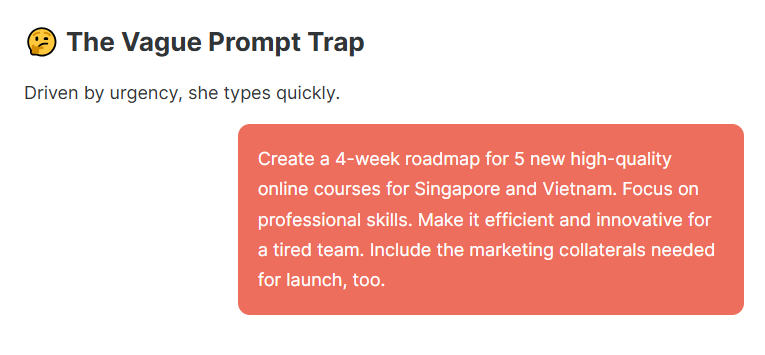
Reactive AI use in a high-pressure workplace scenario.
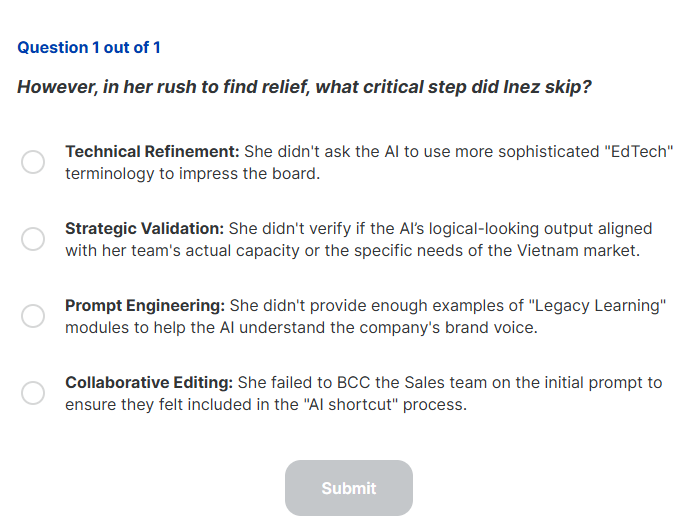
Pinpointing the missed critical thinking gap.
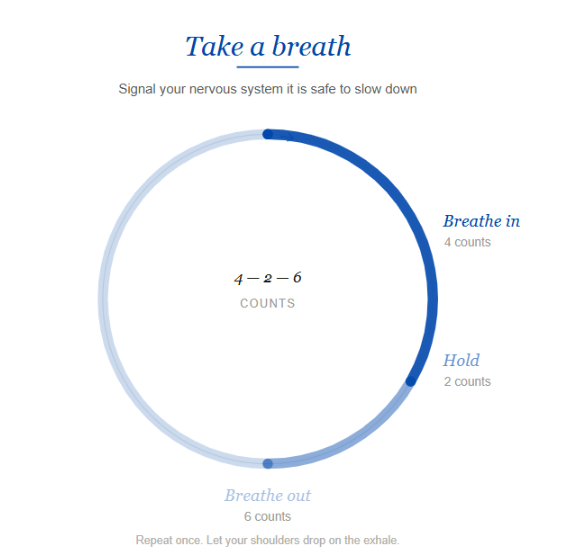
Applying STOP method before generating prompts.
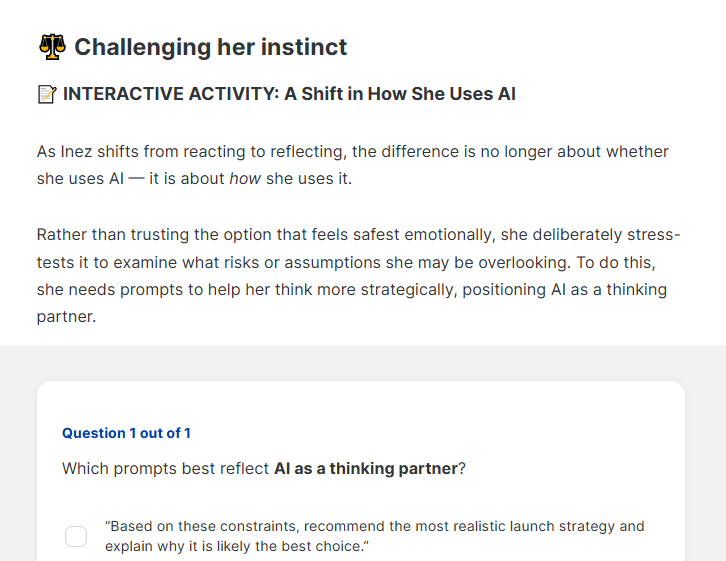
Evaluating AI options and challenging assumptions.
What I'd Improve Next: Prototype Concepts
These concepts represent future product design explorations to expand scenario realism and emotional depth.
Multiple AI Recommendations
Replace linear answers with branching AI trade-off comparisons.
Digital Workplace Environment
Simulate real-time messaging, emails, and AI requests under time pressure.
Experiential STOP Interaction
Paced breathing and somatic awareness widget to bring physiological pause to life.
Feedback & Key Takeaways
What Judges Praised
- ✓ Seamless behavioral science integration
- ✓ Compelling high-pressure scenario narrative
- ✓ Practical learning transfer to real workplace situations
Areas for Next Growth
- — Expand non-linear branching choices
- — Streamline dense text screens into bite-sized interactions
- — Enrich visual polish of interactive decision screens
AI accelerates exploration without replacing human design judgment.
Emotional regulation must precede cognitive critical evaluation under pressure.
Effective AI learning design focuses on the condition of the user, not just prompt syntax.
A realistic pressure scenario helps learners recognize their own habitual shortcuts.