Pre-School and K-12 Learning Modules for Sekolah.mu

Role
Learning Designer
Timeline
2021–2022
Audience
Ages 3–11
Status
Archive

How can inquiry-based learning grounded in real-world contexts develop deeper thinking in Indonesian learners, and what role does blended learning design play in making that work?

The Challenge: Shifting from Rote to Relevant

From 2021–2022, I transitioned from Learning Strategist Intern to Learning Designer at Sekolah.mu, building blended modules for Maths, English, Science, Motoric Skills, and Social-Emotional Learning.

Coming from a public school background focused heavily on rote memorization, it was deeply fulfilling to design the exact opposite. Navigating this during the COVID-19 crisis taught me how to fiercely protect valuable learning moments and design for resilience when conditions are less than ideal.

My role was to turn Sekolah.mu’s core philosophy: the freedom to learn, collaborate, and create: into a tangible learning reality. Working within an established framework of sub-competencies, I was responsible for the architectural alignment, mapping every learning objective and activity to ensure the modules delivered on the promise of deep, human-centric growth.

The Core Insight: Inquiry-based learning grounded in real-world contexts is the bridge that moves students from procedural thinking to transferable understanding.

In blended environments, this happens when: 1) async work introduces questions, not answers, and facilitation deepens thinking; and 2) teachers build a positive environment with psychological safety.

The Impact: Redefining the Learner Ecosystem

Philosophy

Competency-based learning, humanizing approach

A framework that centres real skill development and treats every learner as a whole person with distinct needs, interests, and pathways.

Design & facilitation

Modules aligned to competencies, built with students

Learning designers map activities to chosen competencies. Facilitators co-construct knowledge with students, fostering psychological safety and a positive learning environment.

Student outcome

Skills that transfer beyond the classroom

Students build the competencies PISA measures: critical thinking, problem-solving, communication: skills that hold up in real-life contexts.

The loop: Real-world relevance motivates inquiry → inquiry deepens understanding → deeper understanding builds transferable competence.

Pedagogy in Practice

Science

Sparking Curiosity Architecture, History, and Arts

Rather than explaining sound waves immediately, students are led to ask: Can we see sound? This is followed by an at-home experiment where students generate evidence, then we formalize the concept together in live class.
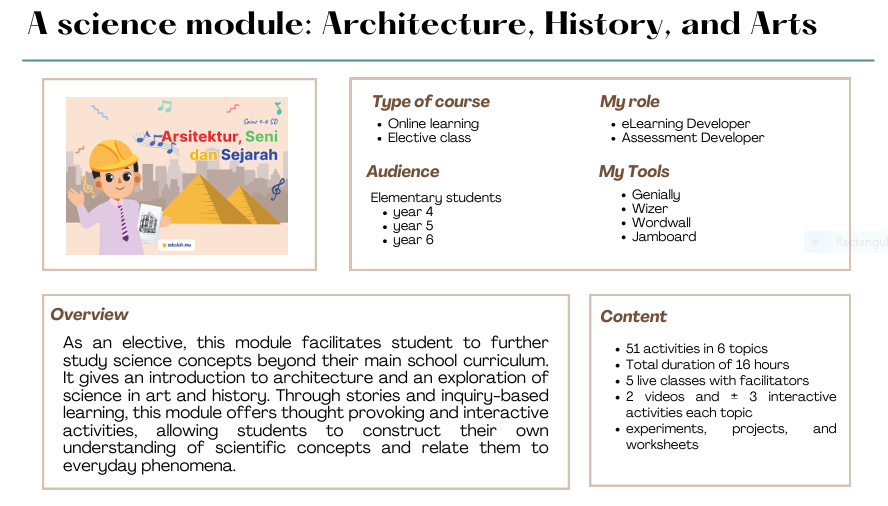
Science Module: Architecture, History, and Arts
Mathematics

Real-World First An exploration of geometry and numbers

Students start with relevance: 'Why do museum models look right?' This anchors abstract proportion work. Open-ended Padlet discussions before live class let students wonder aloud, so facilitators can address misconceptions.
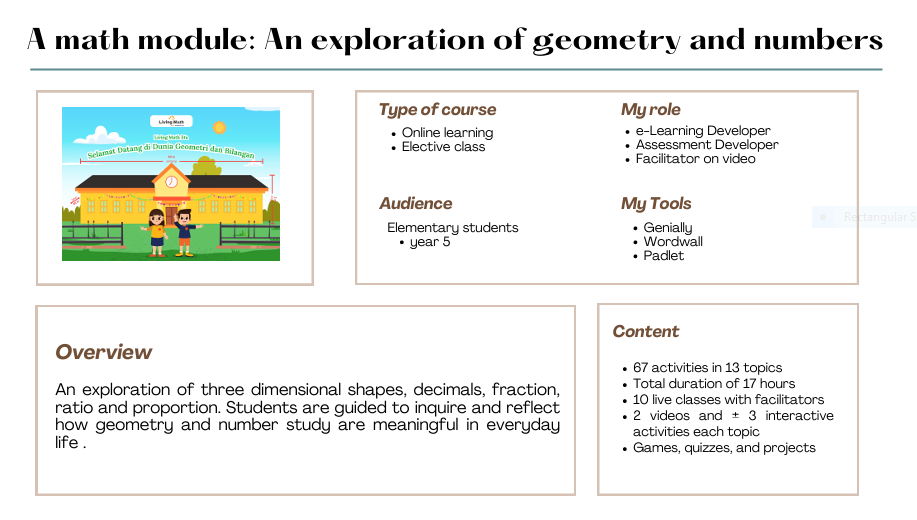
Math Module overview

Module overview

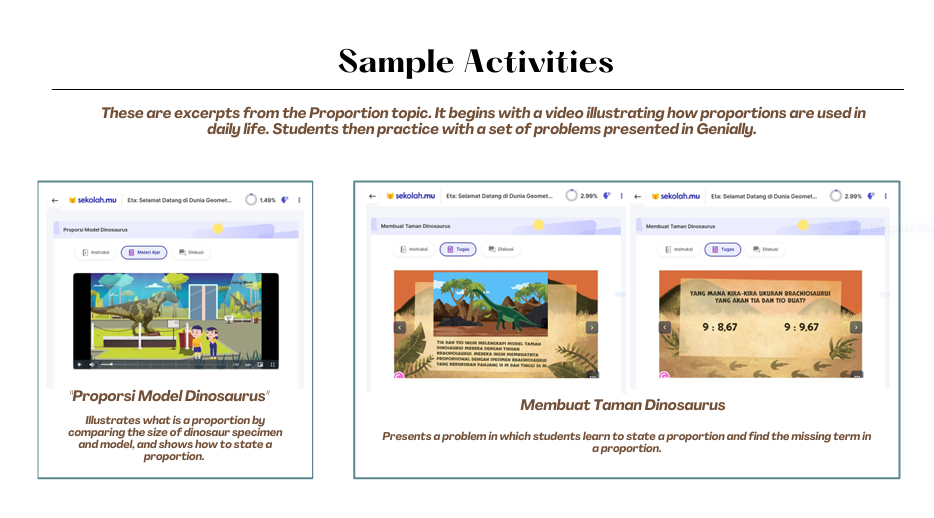
Sample proportion activities in Genially

Sample activities: interactive proportion problems in Genially

Social-Emotional Learning

Embedding in Daily Practice Social awareness

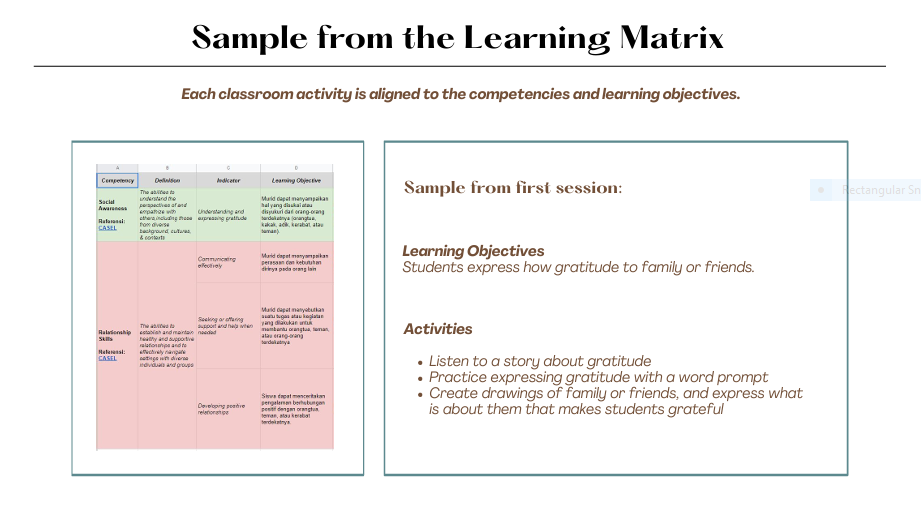
Students are introduced to gratitude by listening to stories, drawing people they care about, and speaking about why. The competency emerges from doing, not being told.
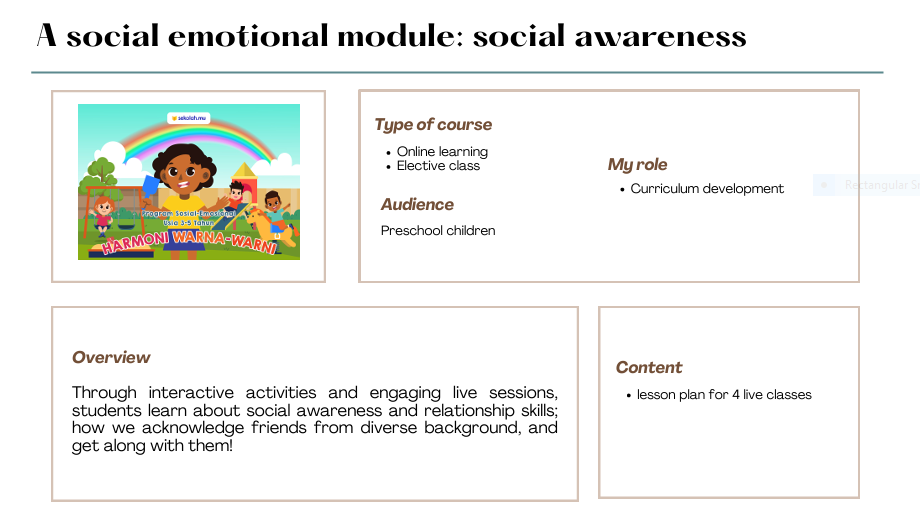
SEL Module overview

Module overview

Learning matrix aligning activities to competencies

Learning matrix aligning activities to competencies

The Blended Learning Piece

In each module, asynchronous work does the heavy lifting of asking questions. Videos and interactive activities introduce 'puzzles' students need to solve. Live facilitation then becomes about enabling inquiry: facilitators listen to student thinking, ask follow-up questions, and help students see patterns. This separation allows students thinking time; it prevents facilitators from rushing to answers.

Reflections: Designing for Real Context, Not Ideal Conditions

I designed inquiry-based, blended modules emphasizing deeper thinking and real-world relevance. This work taught me that strong pedagogy isn't enough: learning design succeeds or fails based on how well it accounts for real constraints: market positioning, user capacity, and systemic pressures.

Design challenge: Cultural Friction in Inquiry

Inquiry-based learning doesn't transfer automatically across pedagogical cultures. Indonesian students are historically trained for procedural, answer-focused learning. Moving them from "I don't know the answer" to "I want to figure this out" required massive scaffolding. I learned that designing for inquiry means designing for the facilitator's capacity just as much as the student's.

Product challenge: Pedagogy vs. Market Reality

Framed as electives, these modules thrived during COVID but struggled post-pandemic. It forced a hard question on product-market fit: Does transformative pedagogy need to be framed as core curriculum to survive? I realized I had designed for ideal home environments that simply didn't exist for every user.

System challenge: The Durability of Competencies

I designed for inquiry and curiosity, but users operate under the very real pressures of test scores and admissions. I am now questioning how to balance systemic pressures with pedagogical ideals: Who actually decides what competencies matter most?

Questions I'm Exploring Next

Can inquiry-based learning be designed to serve both deeper thinking and measurable outcomes families care about, or are they fundamentally at odds?
Who actually benefits from blended learning, and what supports do different students need to succeed in this format?
How do I design for the real constraints families face: economic pressure, admissions stakes, limited home support: rather than the ideal scenario I assumed?
Back to Portfolio