Note: This is a conceptual project designed for this portfolio. The design, architecture, and evaluation framework are fully realised; the Storyline module and AI coach are functional prototypes, not deployed or validated products.
The Problem
A high-pressure test that requires the right strategy
- No single correct answer; judged across four interdependent criteria
- 60-minute time limit, with Task 2 weighted double
- Without a strategy, performance stays inconsistent under pressure
Financial cost barriers
- Many learners prepare independently due to cost barriers
- Without structure, practice becomes inconsistent and poorly targeted
- Repeated attempts compound financial strain and erode confidence
Design Question
How can you provide a self-directed learner with the structure of a coached session: without a coach, without an LMS, and without a large budget?
Learning Needs Analysis
The core gap here is not a lack of knowledge of IELTS criteria. Many Band 6.5 learners can identify the assessment criteria, yet still struggle to apply them consistently under test conditions.
What is happening to the learner?
Can identify IELTS assessment criteria, yet struggles to apply them consistently under real test conditions.
Self-Regulated Learning
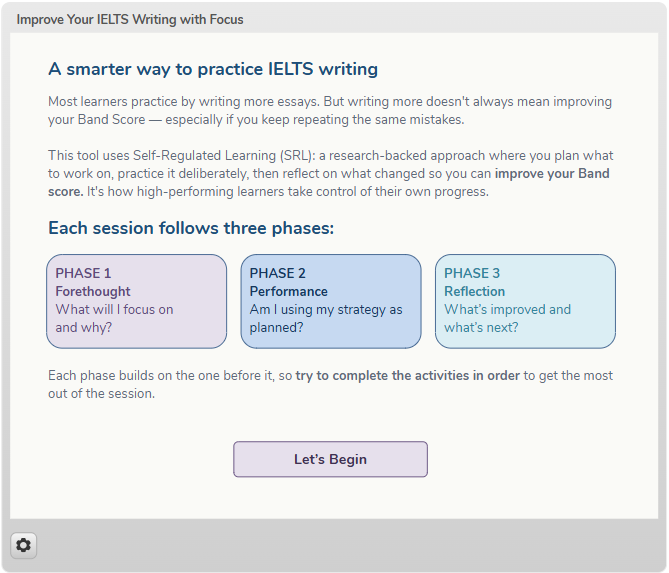
Grounded in Zimmerman’s SRL framework: three phases (Forethought, Performance, Reflection), practiced as a cycle rather than taught as content.
What does this affect?
Strengthens goal-setting, reflection accuracy, and metacognitive calibration; shifts learners from passive practice to intentional, data-informed learning.
The Three-Phase Design
Rather than explaining what SRL is, every scene in the module requires learners to do what self-regulated learners do.
Forethought
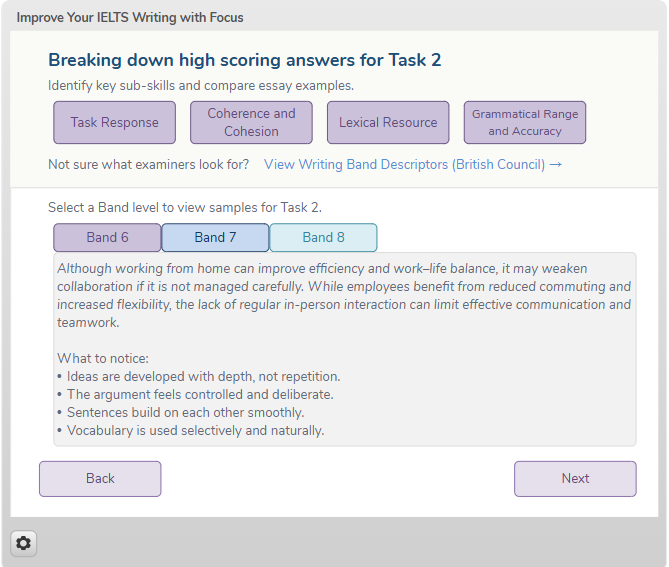
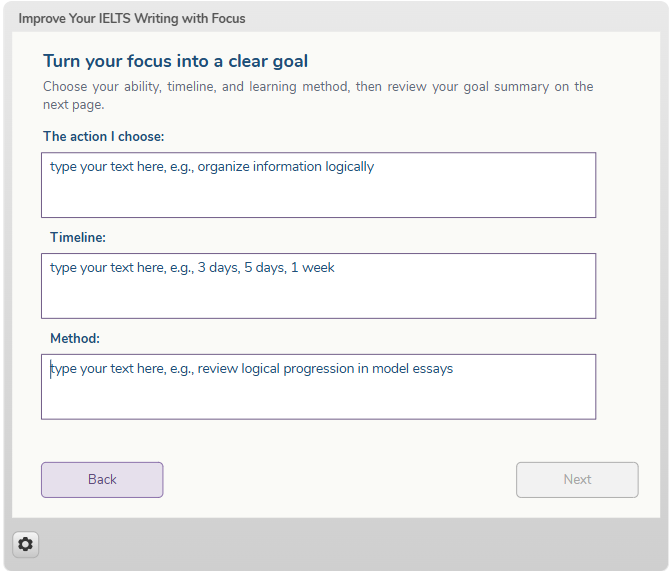
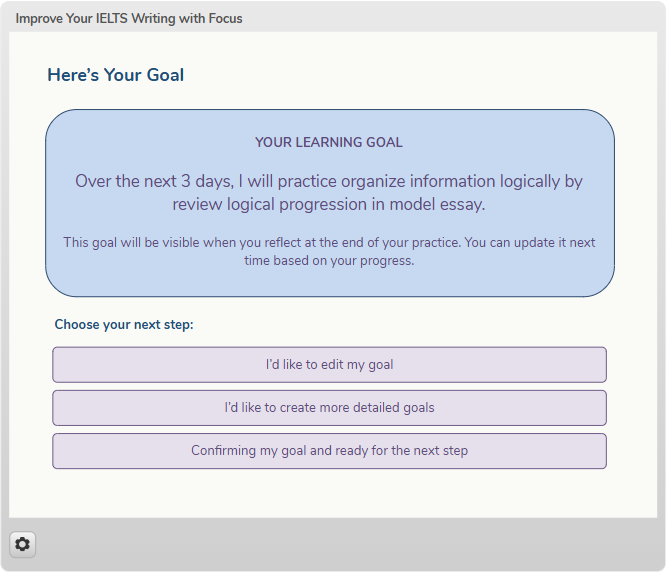
Band gap analysis, scaffolded goal-setting with sentence stems, motivational grounding, and anxiety reframing. Learners identify their own gap before setting a target.
Performance
Learners submit a full essay to the AI writing coach. They receive their primary gap, a sample of improved text, and targeted practice suggestions.
Reflection
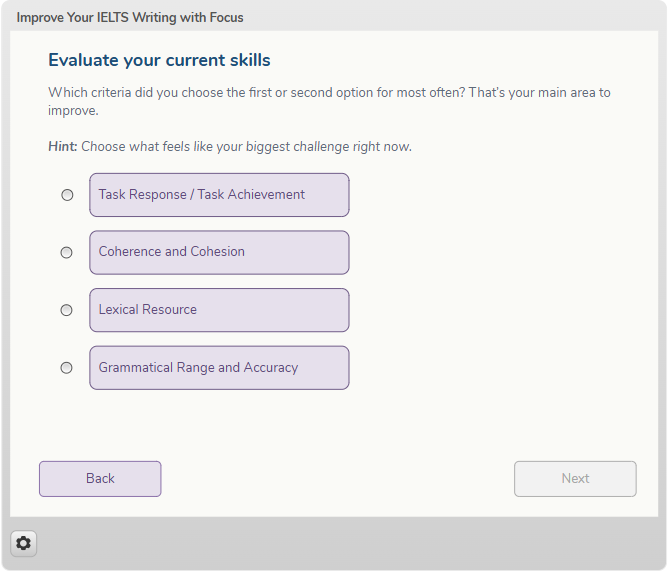
Three sequential cognitive moves: evaluate accurately, decide adaptively, commit specifically. Every prompt targets a specific self-regulatory behaviour with a theoretical basis.
The Learning Ecosystem
Two learner-facing products carry the experience. Storyline manages the session architecture; the AI coach provides adaptive, essay-specific feedback.
Articulate Storyline 3
assets/storyline-01.png
assets/storyline-02.png
assets/storyline-03.png
assets/storyline-04.png
assets/storyline-05.png
assets/storyline-06.png
assets/storyline-07.png
Welcome screen introducing the SRL approach and the three phases: Forethought, Performance, and Reflection.
IELTS AI Writing Coach
assets/ai-coach-01.png
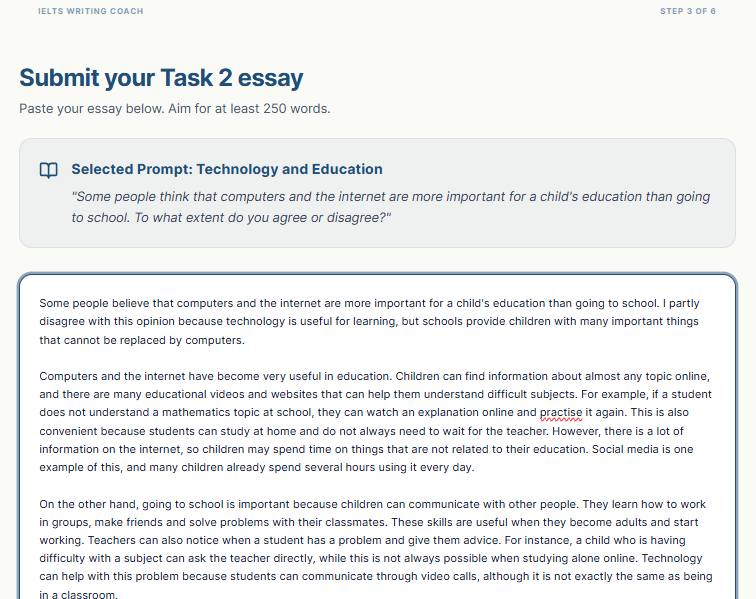
assets/ai-coach-02.png
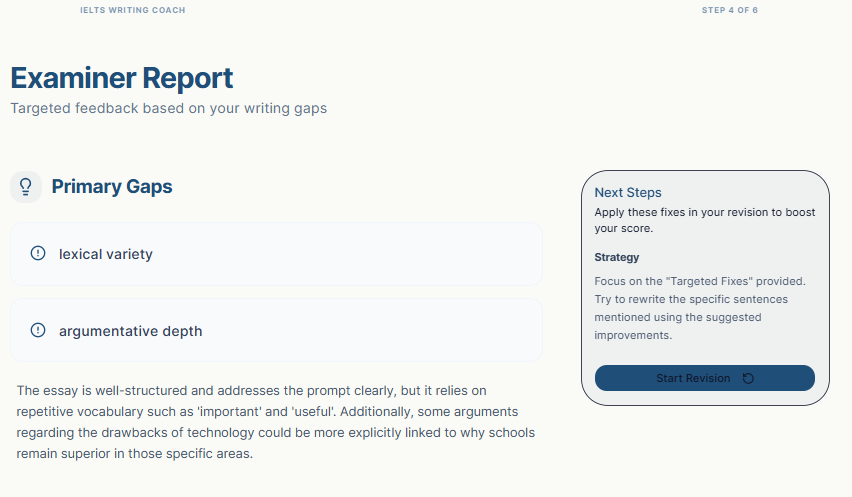
assets/ai-coach-03.png
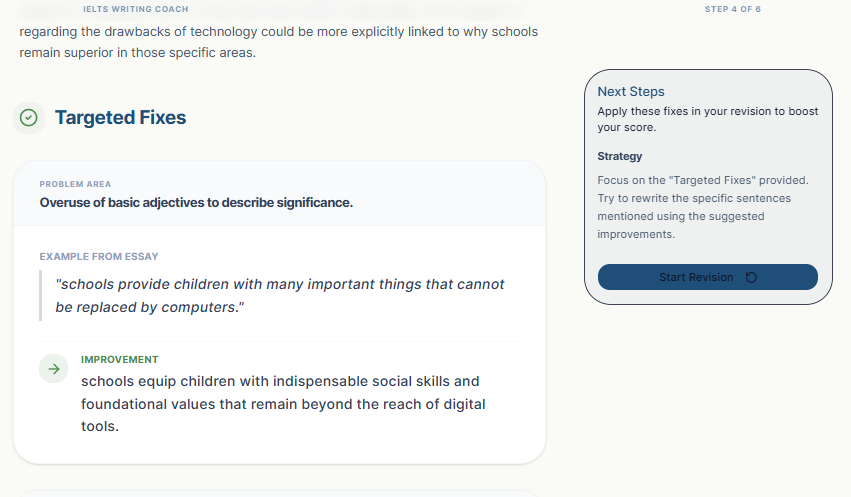
assets/ai-coach-04.png
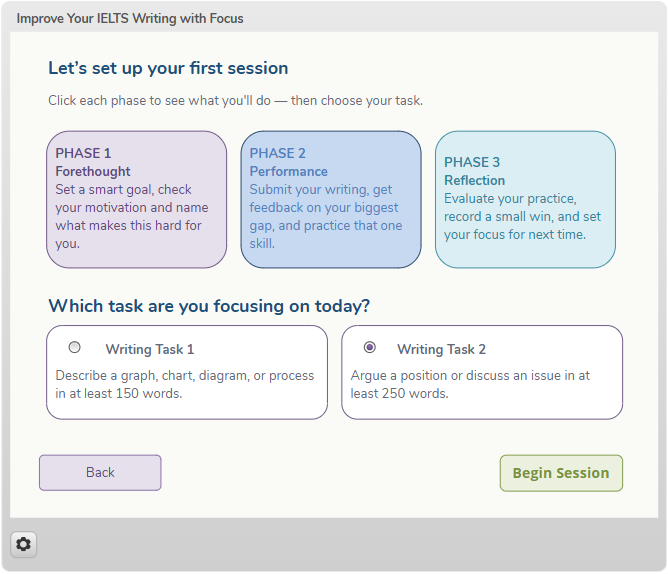
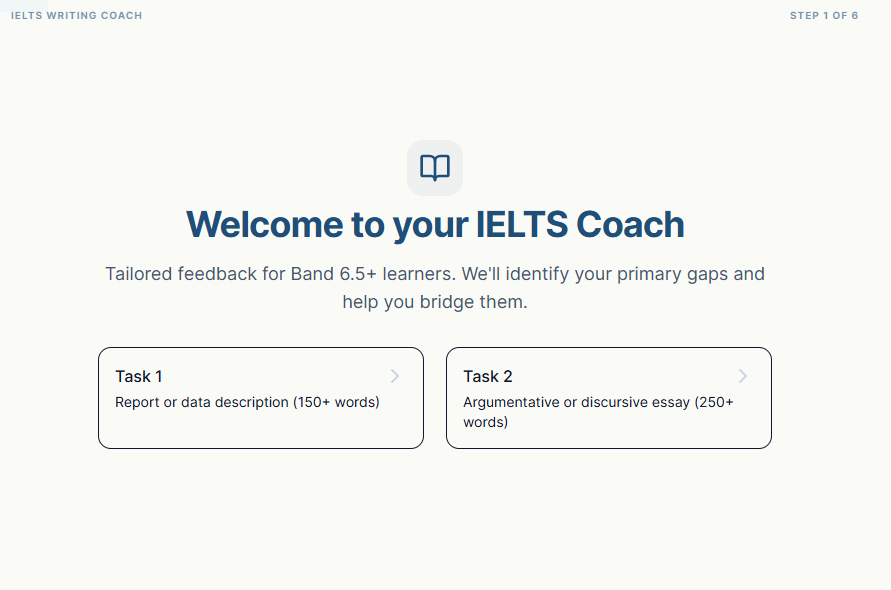
Welcome screen: learner selects Task 1 (report/data description) or Task 2 (argumentative essay).
JavaScript + Google Apps Script
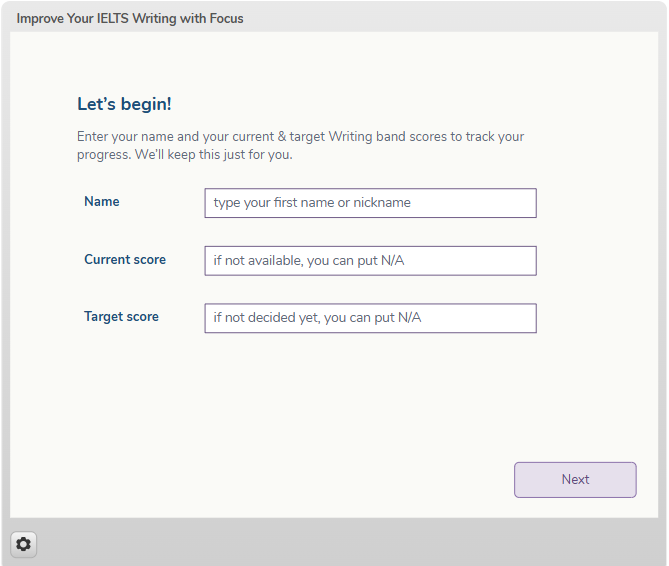
Chosen as the evaluation layer for LMS-free, zero-cost deployment. A Google Apps Script Web App receives all 27 session variables from Storyline, writing each completed session as a new row.
Google Sheets
The evaluation backend. Each completed session writes one timestamped, learner-named row, with all Forethought, Performance, and Reflection variables stored in structured columns.
Learning Evaluation
Core question: Does repeated use of this tool build self-regulation in IELTS writing learners over time?
- Goal quality: does
smart_goal_actionbecome more specific, andsmart_goal_weeksmore realistic? - Anxiety & self-efficacy trajectory: does the tone of
struggle_reframeandself_efficacybecome more confident over sessions? - Engagement:
session_counttracks how many full cycles each learner completes; drop-off rate indicates where motivation breaks down.
- Self-diagnosis accuracy: does
criterion_focusstart matchinggap_identifiedmore often? Mismatches are expected early; convergence is expected over time.
- Reflection depth: do
improvement_attributionresponses shift from surface (“I did better”) to causal (“I improved because I focused on topic sentences”)?
- Adaptive behaviour: does
new_criterion_focusshow variety across sessions, or does the learner stay stuck on one criterion?
Also tracked across sessions: correlation between session_count and current_band_score. Improvement here is defined not only as higher band scores, but as better regulation of the writing process itself.
Development Materials
Full documentation, including the Learning Experience Matrix, AI Coach Development Log, Google Apps Script, and Storyline JavaScript trigger, is available below. In a real production environment, I would continuously refine the AI Coach to enhance its accuracy and reliability.
References
- Zimmerman’s overview for the phase structure and theoretical legitimacy. Link
- Panadero’s review for broader SRL model support and the forethought-performance-reflection framing. Link
- A study on self-regulated writing intervention for English learners, arguing that SRL in writing is teachable and improves with practice. Link
- A writing-performance study showing correlations between SRL strategies and writing outcomes. Link
The Storyline Module
Reflection
The pivotal moment was refining the approach from teaching about SRL to designing through it. During the course outline matrix development, every scene was reframed: does this prompt action or reflection, or just comprehension? That single question restructured the entire learning architecture.
The current version provides one practice prompt per session. A production version would expand prompt variety and invest further in the Storyline UI/UX: developing a visual language that reinforces self-regulation, calm, focused, and intentionally unhurried. The interface should signal that this is a space for reflection, not speed. The goal would also be better visual cohesion between the Storyline module and the AI writing coach so they feel like one ecosystem rather than two adjacent tools.
This learning experience builds the internal process of self-regulation. But self-regulation doesn’t mean learning alone: writing improves through feedback, diverse models, and engagement with a learning community. This tool is one part of a larger ecosystem. It doesn’t replace the external environment, and it was never designed to.